
For the conventional dataset, based on existing public datasets, we employ Graph Convolutional Generative Adversarial Networks (GC-GANs) to extract correlation features between different data types. During parameter iteration updates, we incorporate physical constraints such as signal attenuation, while integrating operational characteristics of wind turbines, photovoltaics, and loads. The data generation results are as follows:
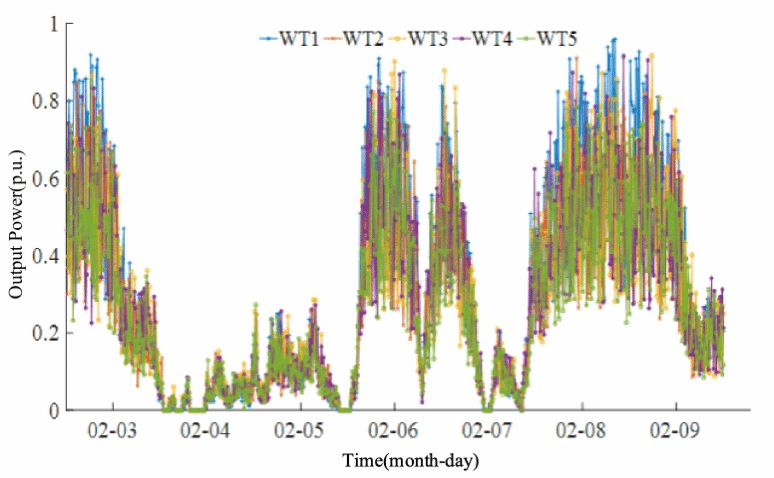
Time-Series Power Output Data for WT1-WT5
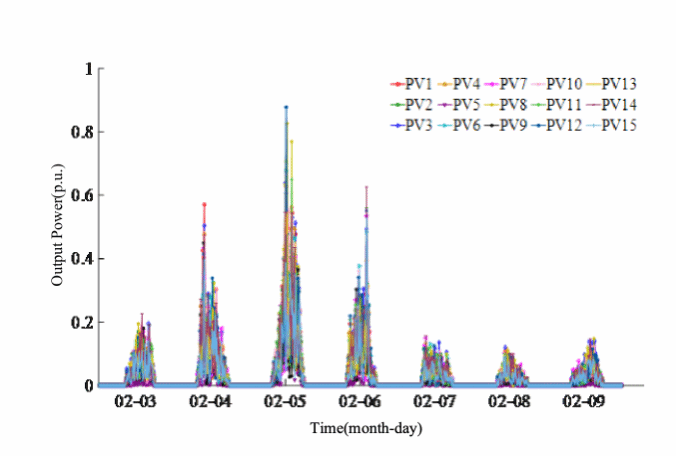
Time-Series Power Output Data for PV1-PV15
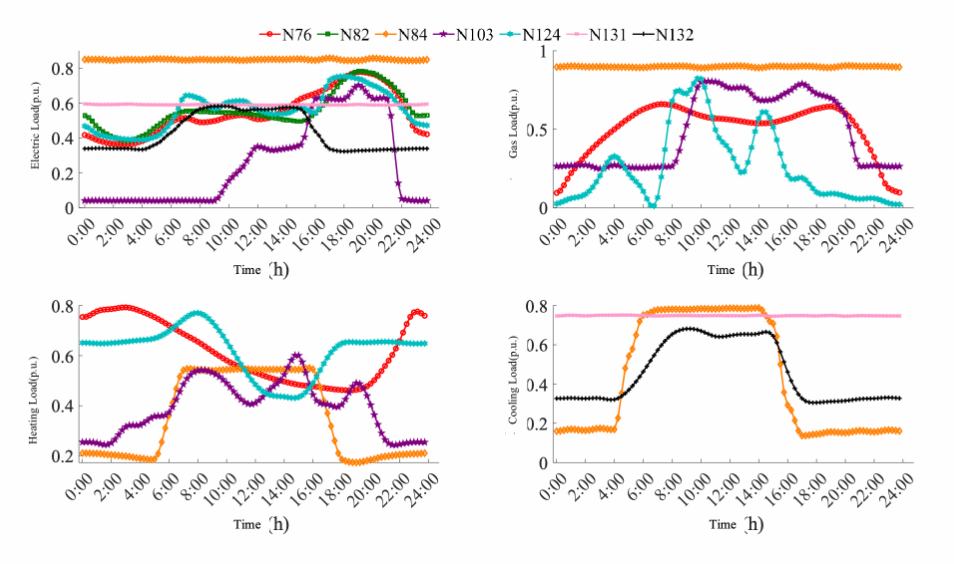
The Hourly Average Load of Different Load Types Throughout the Year
The results demonstrate distinct diurnal and seasonal patterns in renewable generation and load profiles. Wind turbine output is significantly higher during nighttime than daytime, exhibiting pronounced daytime fluctuations, while photovoltaic generation concentrates in daylight hours with more volatile intra-day variability due to cloud cover effects. Seasonal analysis reveals wind power output is 15% higher in autumn/winter compared to summer, whereas PV generation peaks in summer with 20-30% higher output than other seasons, directly correlating with solar irradiance intensity.
Load profiles show characteristic variations across energy types. Electrical loads display dual-peak patterns (morning/evening) for residential, EV charging, and public service nodes, while industrial and data center loads maintain stable baseload profiles. Gas loads follow similar diurnal trends to electrical loads but with minimal seasonal variation. Thermal loads exhibit inverted patterns between residential (night-dominant) and commercial/public (day-dominant) nodes, with industrial demand exclusively appearing in winter. Cooling loads surge by 40% in summer for industrial/data center nodes, whereas warehouse cooling remains stable year-round. Seasonal impacts are systematic: summer brings peak PV generation coupled with elevated electrical/cooling demand, while winter optimizes wind power output and maximizes thermal load requirements. The annual dataset captures these cyclical interactions between climate-dependent generation and usage patterns across all energy vectors.
Visits:524811
Downloads: 52602
Data Submissions: 9274