
Anomaly Dataset
Using transfer learning and multi-physics coupled simulation methods, we have constructed a short-term anomaly dataset covering extreme weather events, system failures, and their composite scenarios. Compared to the standard dataset, the anomaly dataset exhibits more complex spatiotemporal patterns and is subject to disturbances from extreme meteorological factors, resulting in more pronounced random fluctuations in both source and load nodes. However, the characteristic variations and inter-node correlations remain consistent. Therefore, the anomaly dataset was developed through transfer learning based on the existing conventional dataset model.
Extreme Weather
Four types of extreme weather conditions were included: Cold waves、Blizzards、Heat waves、Prolonged windless periods,the data generation results are as follows:
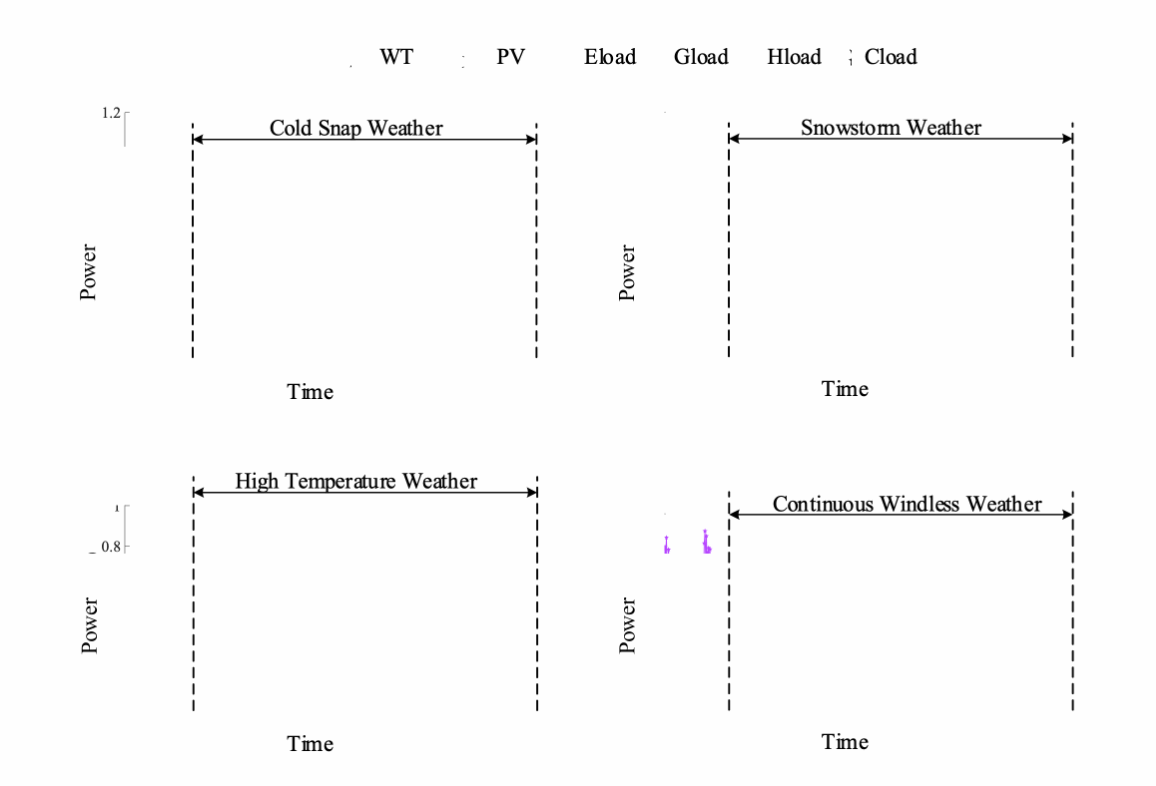
System Data Generation Under Extreme Weather Scenarios
During cold wave events, the system experiences significant load impacts with peak electrical, gas, and thermal loads rising to approximately 1.7x, 1.8x, and 2.1x of normal values respectively, while load peak-valley differences widen. Under persistent blizzard conditions, overall electrical and thermal loads increase whereas PV output declines due to snow coverage on panels and reduced irradiance. Heat waves drive up electrical and cooling loads concurrently, but PV generation efficiency decreases with rising ambient temperatures, resulting in output reduction. During prolonged windless periods, when wind speeds remain below turbine cut-in thresholds for over 5 consecutive days, wind power generation drops below 20% of installed capacity, failing to provide adequate power supply to the distribution network.
Additionally, the research team has developed specialized anomaly datasets encompassing both standalone system failures and compound extreme weather-failure scenarios. The complete datasets are available for download via the official data repository.
Visits:524811
Downloads: 52602
Data Submissions: 9274