
Model construction
Reliability assessment is crucial for real-time monitoring of system status, quickly identifying potential weak points, predicting short-term risks, and formulating preventive measures to ensure system stability and safety under varying internal and external factors.
Model construction involves modeling the time-varying characteristics of equipment state probabilities and supply-demand uncertainties, which is central to operational reliability assessment in integrated energy systems (IES). This differs from traditional reliability assessment by accounting for the diversity of equipment operating conditions and the randomness of internal failures. Equipment operational uncertainty primarily stems from load variations and renewable energy intermittency. The Markov multi-state method is a common approach for modeling IES equipment operational reliability, leveraging its "memoryless" property where future states depend solely on the current state. Considering that the states of distribution network components and renewable energy sources (such as wind and solar power output) are not mutually independent but transition sequentially from one state to another via a state transition matrix, the sequential Monte Carlo method leverages this relationship for accurate state sampling. This approach provides a more precise and realistic assessment, enabling reliability analysis to better reflect actual system operation.
Evaluation Results
Through a continuous 8760-hour simulation, the reliability assessment of the IES-134 system yields the following results:
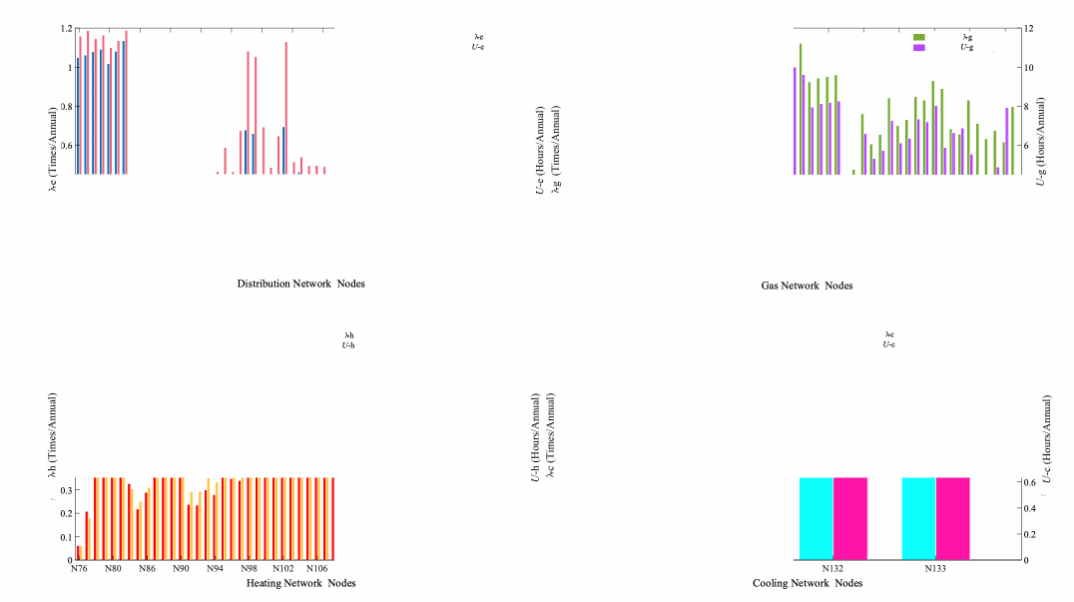
Reliability Calculation Results for Load Nodes in IES-134 System
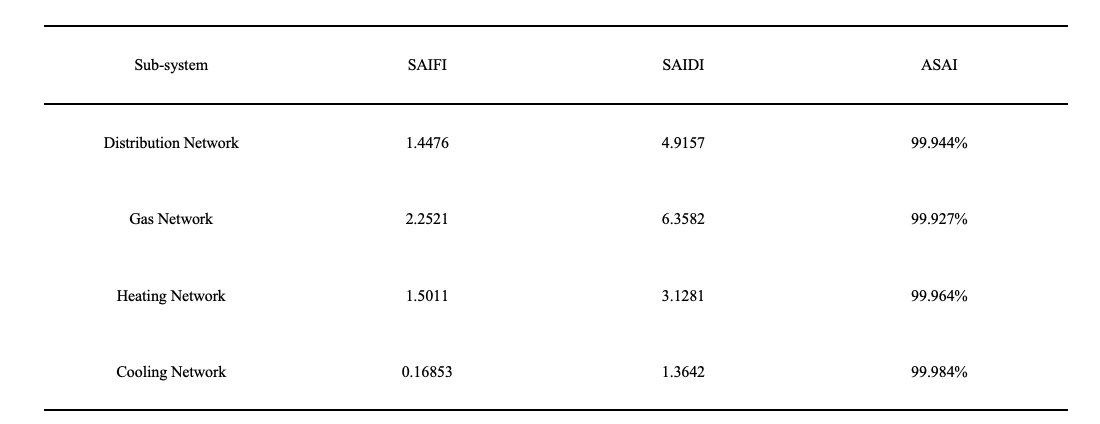
Comprehensive Reliability Assessment of IES-134 System
The results indicate that all load nodes meet reliability requirements, with each subsystem achieving a reliability rate (ASAI) exceeding 99.9%, which complies with the design standards of energy systems.
Visits:524811
Downloads: 52602
Data Submissions: 9274